Independent publisher says Wednesday night’s deal lets four publishers take the money, and every safeguard for smaller publishers sits in a fund designed to stay empty.
Sydney, Australia – 13 August 2026 – Man of Many, one of Australia’s largest independent digital publishers, says the amendments to the News Bargaining Incentive agreed between the Prime Minister and the Opposition Leader on Wednesday night improve the size of the pool while removing the only constraint on how few publishers can absorb it. The bills were introduced today. A Senate vote is expected next week.
What the government got right
Man of Many wants to be clear about what has improved, because a good deal of it has.
- The universal levy closes the loophole that made the original Code unenforceable, where a platform could remove news and walk away.
- Professional networking services have been brought into scope.
- The offset for deals with small and medium publishers has been lifted to 200 per cent, against 150 per cent for everyone else.
- The definition of who counts as a journalist has been broadened to include freelancers and other essential news roles, which reflects how independent newsrooms actually operate.
- The distribution scheme increases flows to regional journalists, to small and medium publishers, and to outlets serving communities that have historically been underserved.
- Wednesday’s deal shortened the revenue base by a year, which makes the levy bite on more recent and therefore larger platform revenue.
“Anyone claiming the government has not listened is not reading the same document,” said Scott Purcell, Co-Founder of Man of Many. “Most of what the independent sector asked for is in here. What Wednesday night changed was not the size of the pool. It was how few publishers are allowed to stand in front of it.”
What changed on Wednesday night
Four amendments, and they do not pull in the same direction.
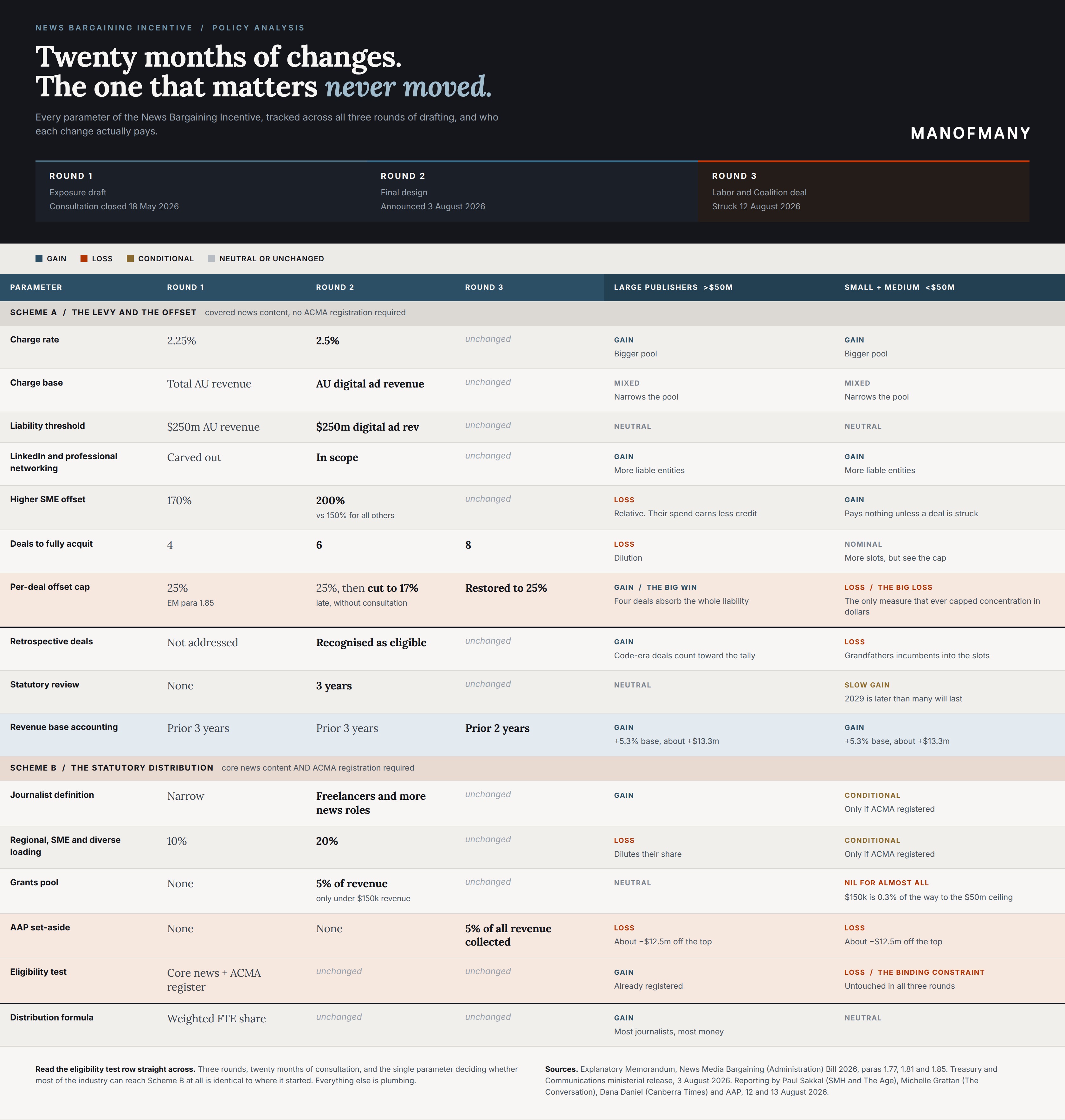
- The per-deal offset cap was restored to 25 per cent. It had been cut to 17 per cent in a late change made without consultation. Australia’s largest publishers objected publicly. It was withdrawn inside a week and nothing replaced it.
- The number of deals required to fully discharge a platform’s liability rose from six to eight.
- Australian Associated Press was allocated 5 per cent of any revenue collected under the scheme.
- The revenue base moved from the third-most-recent financial year to the second-most-recent, so the charge is calculated on more recent, larger revenue.
Eight deals, four cheques
The two headline amendments have to be read together, because they cancel each other out and then some.
The Explanatory Memorandum at paragraph 1.85 is explicit that the cap operates on the platform’s liability, not on what a publisher receives: an entity “may not use so much of a particular total as exceeds a quarter of that NMI amount payable”.
- At a 25 per cent cap, four deals absorb a platform’s entire liability.
- The eight-deal requirement then governs only how many publishers get a deal, not how much any of them gets.
- A platform can therefore write four large cheques that extinguish its bill, bolt on four token deals to satisfy the count, and comply in full.
- At the withdrawn 17 per cent cap, no combination of fewer than six meaningful deals could reach 100 per cent. The money itself had to travel further.
The 17 per cent cap was the only amendment in the entire package that constrained concentration in dollars rather than in deal counts.
“Raising the deal count while restoring the cap trades a real constraint for a nominal one,” said Purcell. “Eight publishers get a phone call. Four get the money. That is not a drafting accident, it is arithmetic, and it was pointed out before the deal was struck.”
The Explanatory Memorandum is explicit about why the multiple-deal rule exists at all. Paragraph 1.77 says it prevents a platform “from being able to fully offset its NMI with one large agreement with a single news business corporate group”. Restoring the 25 per cent cap does not defeat that purpose, but it substantially dilutes it. The rule still stops one deal doing all the work. It now permits four to do it.
There are two ways money moves, and they behave completely differently.
- Route A, commercial deals. A platform pays a publisher directly and the spending offsets its charge. There is no requirement that the publisher spend a cent of it on journalism, no reporting obligation, and no conditions. Deals need only be for “covered news content”, the broader standard, and no ACMA registration is required.
- Route B, the statutory distribution. The government shares out levy money collected from platforms that refuse to do deals. This is the only route where allocations are calculated on journalist salaries, the only route carrying the 20 per cent loading for regional, small and diverse-community publishers, and the only route with any conditions attached at all. It requires the narrower “core news content” test and registration on the ACMA register.
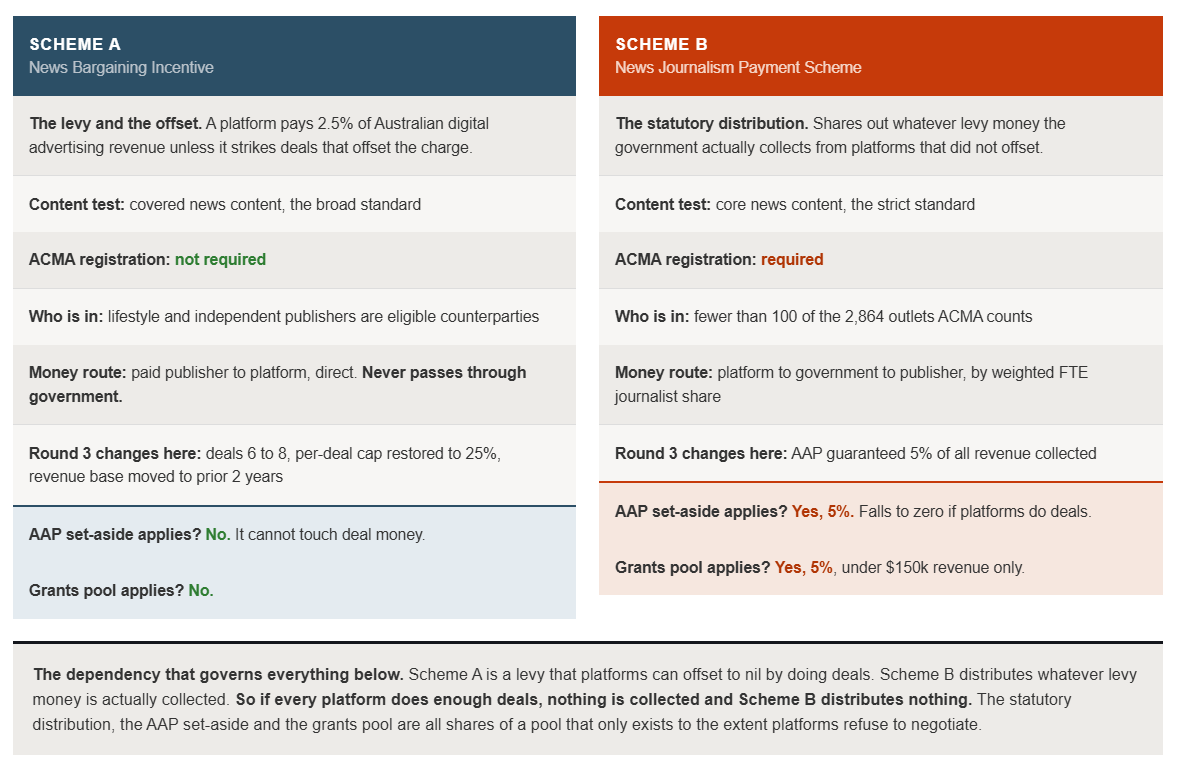
Route B is funded exclusively by platforms that decline to deal. The government’s stated purpose is to induce platforms to deal.
If the scheme works exactly as intended, the pool that funds every measure aimed at small, regional and diverse publishers is empty.
“Every safeguard in this legislation lives on the route the scheme is built to leave unfunded,” said Purcell. “A bigger share of a distribution that never gets collected is worth nothing. That is not a criticism of the drafting. It is the drafting.”
Counted, not committed
Even where the money is calculated on journalists, it is not committed to them.
- Under Route B, allocations are worked out by reference to full-time-equivalent journalist salaries, now including freelancers.
- That is how a share is calculated, not what a share is committed to.
- A publisher can be allocated funds on the strength of the reporters it employed last year, make those reporters redundant, and keep the money.
- Under Route A there is no obligation of any kind.
Nothing in either route prevents it. Treasury’s own statutory review of the Code flagged the absence of any use-of-funds disclosure in December 2022. It has not been addressed.
We have seen this before
Under the News Media Bargaining Code, more than thirty commercial agreements were struck and an estimated $200 million to $250 million a year was flowing at its peak, the substantial majority of it to three commercial publishers.
- In 2024, approximately 450 journalists were made redundant in Australia, overwhelmingly at those same recipients.
- Nine cut 200 roles across broadcast, print and digital, around 90 of them in publishing.
- Seven West Media announced $100 million in cost savings and up to 150 jobs.
- News Corp Australia ran a $65 million cost-reduction program.
The reply to this is that Meta walked away from its Code deals in 2024, so the cuts followed the money stopping rather than the money arriving. That is true, and it makes the point sharper rather than blunter.
“Hundreds of millions of dollars flowed in with no conditions attached, and the moment one platform walked, the newsrooms went almost immediately,” said Purcell. “Unconditional money bought no resilience. That is precisely the argument for maintenance-of-effort conditions, and precisely the argument against a scheme whose only conditioned route depends on platforms refusing to deal.”
Into a market already among the most concentrated in the world
This is not contested, and it does not rest on old data.
ACMA’s own 2025 media diversity report, citing the Global Media and Internet Concentration Project’s September 2024 analysis of Australian markets, records that the data reflects “long-standing media consolidation trends in Australia that are among the highest internationally”, and specifically that:
- there is “high concentration in the newspaper sector, with News Corp Australia, Nine Entertainment Co, Seven West Media and Australian Community Media dominating”;
- there is “increasing concentration in the radio sector”;
- “Google and Meta dominate internet advertising”, which by 2022 had placed them second and eighth on the ranking of the largest communication and media enterprises operating in Australia.
The Public Interest Journalism Initiative has meanwhile recorded 183 newsroom closures and 175 contractions over five years, with the majority of the damage in regional Australia. There are 29 local government areas with no local print or digital news outlet of any kind.
That is the market this money is about to be routed through. The question is not whether Australian journalism needs support. It plainly does. The question is whether routing it through the four groups the regulator names as dominating the sector makes that structure better or worse.
A competition remedy that reduces competition
This scheme did not begin life as media policy. It began as competition policy, and that is what makes the final design so difficult to defend. The Department of Infrastructure’s own consultation paper records the origin plainly. The original Code “aimed to address the bargaining power imbalances between large digital platforms and Australian news businesses identified by the Australian Competition and Consumer Commission in its final report on the Digital Platforms Inquiry in 2019.”
A competition regulator identified a market failure. The remedy built on top of that finding now works like this.
- Public money will be distributed to fewer than 100 registered corporations, in a sector the same regulator measures at 2,864 outlets.
- The restored 25 per cent cap means four publishers can absorb a platform’s entire liability, with four token deals bolted on to satisfy the count.
- Retrospective recognition means the incumbents who already hold Code-era deals are grandfathered into those slots without anything new having to happen.
- Every publisher outside the gate then competes for the same readers and the same advertisers as a rival whose journalism is being part-funded by a government scheme.
That last point is the one that should concern the ACCC now. This is no longer only a question of platforms versus publishers. It is a subsidy delivered to a handful of the largest players in an already concentrated market, and withheld from the rest of it, which places every unfunded Australian publisher at a severe competitive disadvantage against a funded competitor.
“A remedy the ACCC set in motion to correct a market imbalance is about to create a domestic one,” said Purcell. “It concentrates money and bargaining power in the four groups the regulator already names as dominating the sector, and it does that by design rather than by accident. A scheme born out of a competition inquiry should not end up reducing competition, and as drafted that is exactly what it does.”
The same regulator counts 2,864 outlets and would fund fewer than 100
- ACMA’s 2025 report identifies 1,818 Australian news brands comprising 2,864 professional news outlets.
- ACMA’s Register of Eligible News Businesses has ever listed fewer than 100 news business corporations, and has lately been revoking rather than adding.
- The same regulator measures the industry at 2,864 and would fund it at under 100.
ACMA’s Media Diversity Measurement Framework already contains workable definitions arrived at through public consultation, and updates every two years. The government does not need to invent a new gate. It needs to use the one its own regulator has already published.
The new grants program concedes the point at the bottom of the market, by funding publishers below $150,000 in revenue who cannot get onto the register. It does nothing for the middle: established businesses well above that threshold, employing working journalists, shut out by an undefined test of what counts as news.
Our interest, declared
Man of Many is a digital publisher. It was registered on the ACMA news register, was revoked on 13 January 2026 under section 52H(2)(a) with the corporation revoked under section 52H(5), and is reapplying. If eligibility were broadened, Man of Many could benefit. Readers are entitled to weigh what follows against that.
- Man of Many employs working journalists producing original reporting on consumer protection, product safety, financial wellbeing, health and sustainability, alongside its lifestyle coverage.
- The reasoning for revocation relied on the same categories of article that were present when ACMA registered the business. The editorial position had not changed. The interpretation had.
- Broadsheet Media and Urban List were revoked on the same day on the same grounds. All three are Mumbrella Publish Award-winning independents.
“Nothing we published changed. The regulator’s reading of an undefined word changed,” said Purcell. “If eligibility can move underneath a publisher without the publisher doing anything, it is not a standard. It is a judgment call, and a business cannot plan around it.”
Man of Many is not asking to be paid. It is asking for money that carries conditions, and for a gate wide enough to admit the working newsrooms the regulator already counts. Every condition set out below would apply to Man of Many exactly as it applies to Nine, and Man of Many would accept all of them tomorrow.
“We are not here asking for a handout, and we would rather be excluded from a scheme that works than included in one that does not,” said Purcell. “What we are arguing for is that public money for journalism reaches the breadth of the Australian media sector and actively supports diversity in it. Not a larger slice for us. A wider table.”
What Man of Many is asking for
The bill has not passed. None of the following weakens the scheme, reduces what platforms pay, or takes a dollar from any existing recipient. Each of them is aimed at the same objective: that the money reaches the breadth of the Australian media sector and actively supports diversity within it, rather than concentrating further in the few groups that already dominate it.
- Attach conditions to the money. Annual reporting on journalist headcount and spend, verified by payroll evidence on the JobKeeper model, and an allocation that falls if a recipient’s newsroom does.
- Adopt ACMA’s own Media Diversity Measurement Framework definitions as the eligibility basis. They are already operationalised, already consulted on, and they capture the actual industry.
- Use one definition of news, not two. The bill applies two different tests to the very same journalism. A platform earns its offset by spending on “covered news content”, the broader test. A publisher can only receive money from the distribution scheme if it produces “core news content”, the narrower test. So the same article can be worth a 200 per cent credit against a platform’s levy bill when that platform licenses it, while the publisher who wrote it is told it does not produce news when the money is handed out. Either that work is news or it is not. One definition should do both jobs.
- Make the search service definition technology-neutral by removing the exclusion of services that “neither solely nor primarily use large language models” at clause 9(c) of the Administration Bill. As drafted, AI assistants consuming Australian journalism sit outside the regime entirely.
- Publish a costing. The sector is being asked to plan against a figure that appears only in press reporting, with no stated period. Treasury should state what it expects the Incentive to collect, and over what timeframe.
An agreement between the major parties is not the end of the process. The bills were introduced today and the Senate has not voted. Amendments at this stage are ordinary, and none of the five above would reopen the deal Labor and the Coalition struck on Wednesday. They refine where the money lands, not whether platforms pay.
“This is not a reason to abandon the scheme, it is a reason to fix it before it starts,” said Purcell. “The statutory review is three years away. That is a long time to wait for publishers who will not last that long.”
Ends.
For additional information, please contact:
Scott Purcell – Co-Founder, Man of Many – scott@manofmany.com (+61 403 496 680)
About Man of Many
Man of Many is Australia’s largest men’s lifestyle site and the country’s first 100 per cent carbon-neutral digital publisher. Established in 2012, Man of Many’s mission is to inform, engage, and empower Australians with comprehensive, accurate, and timely content across lifestyle, culture, technology, and significant public issues. With over 6 million in global cross-platform monthly reach and over 900,000 social followers, Man of Many provides premium yet approachable content that resonates on a global scale. Proudly independent and award-winning, Man of Many is dedicated to their purpose of empowering people to make positive investments in themselves and their communities.